
How to Build a 2027 Budget From Assumptions, Not Last Year Plus a Percentage
The short answer. Build your budget from assumptions and milestones, not by adding a percentage to last year’s numbers. Every revenue and cost line should trace back to something specific, such as new customers per month, grants expected, or a hire tied to a milestone. Keep the plan conservative, project no more than three years out, and get your team to own it before the board sees it.
What is an assumption-based budget?
An assumption-based budget is a 12-month plan where every number comes from a stated driver. Revenue is built from the customers, contracts or grants you expect to win, month by month. Costs are built from the people you plan to hire and the spending each milestone requires.
The opposite is a percentage budget. It takes this year’s results and applies blanket increases, for example revenue up 40% and expenses up 20%. It is fast to build and almost useless to run.
Why don’t blanket percentages work?
A percentage budget fails for four reasons.
- It tells the team nothing. A 40% revenue target doesn’t say which customers to win, which program to launch or when to hire.
- It invites hidden cushions. Percentage budgets often carry padding in every line, or a plug line at the bottom labeled “cushion.” That is poor modeling. Each number should be conservative because of the assumption behind it.
- It can’t explain the mistake. When results fall short, there is no assumption to check. You only know the number was wrong.
- It hides sandbagging. When managers build their own budgets, they often low-ball revenue and pad expenses so they can beat the plan later. Each budget can look reasonable alone while the combined total shows a loss and a cash shortfall.
Investors and boards know a budget won’t be accurate. What they judge is whether leadership understands the assumptions behind it. The stakes are real. In his book The #1 Key To Creating A Thriving Business, our founder and CEO, James Vanreusel identifies a missed budget as the main reason investors fire CEOs.
What does an assumption-based budget look like in practice?
Here’s a simple example. Say a company starts 2027 with 40 customers, each paying $1,000 a month. That is $480,000 a year. A percentage budget adds 40% and lands on $672,000, with no explanation of how to get there.
An assumption-based budget starts with the sales funnel. The head of sales believes the team can add four customers a month. Sales estimates tend to be optimistic, so the budget uses three.
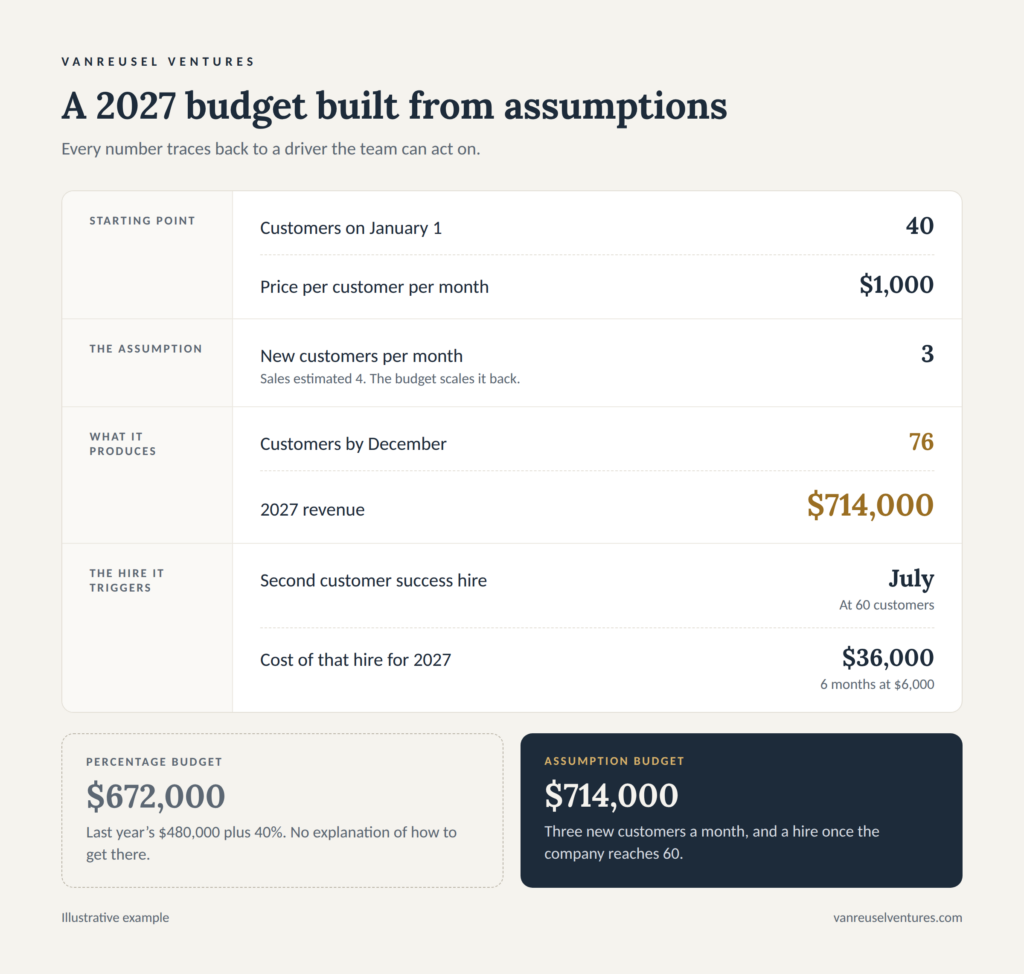
Now the budget says what has to happen. Three new customers a month, and a hire once the company reaches 60 customers. If only six new customers have signed by the end of April instead of twelve, leadership knows exactly which assumption broke. The hire can move back before it becomes a cost the company can’t carry.
How do you build a budget from assumptions?
Follow these eight steps in order.
- Start from a three-year model. A budget is a refinement of your longer-term projections, so build the projections first. Don’t go past three years. Unless your business model is established, years four and five are guesswork.
- Lock down your KPIs for the next 12 months. KPIs connect your revenue lines to your expenses. Choose them before you build anything else.
- Write down every assumption. Give each one a best, base and worst case. Ask your board, investors or trusted advisors to challenge them.
- Build revenue from the bottom up. Go contract by contract, sale by sale or grant by grant for each of the next 12 months. Take the sales estimate, then scale it back. Pay close attention to wins expected late in the year.
- Build costs around people. Decide how many staff you can hire, at what salary, in which month. Separate fixed costs from variable costs, and check that your margin covers the fixed costs. Revenue is uncertain, but expenses are certain.
- Add a monthly cash view. Show the cash you expect at the start of each month. A budget can show a healthy year and still run out of cash in the middle of it.
- Consolidate and challenge. If several managers build budgets, combine them into one model and review the total. That is where sandbagging becomes visible.
- Get the team to own it. The budget is for the team first and the board second. Each team should be accountable for its own numbers before the board sees the plan.
Does assumption-based budgeting work for nonprofits?
Yes. The method is the same. Only the vocabulary changes. Replace customers with grants, contracts, donors or program sites, and replace investors with your board and funders.
One point matters more for nonprofits. The standard split of program, fundraising and administrative costs is useless for management decisions. Build the budget around the real drivers of your work, such as sites opened, people served or staff per program. That gives leadership numbers it can actually manage against.
Frequently asked questions
When should the budget process start?
For a growing company or nonprofit, start in September or October. The board takes a first look in November and gives final approval in December. Larger organizations should start earlier. Waiting until late December, or February, produces a rushed plan nobody can run.
How far ahead should a startup project?
Three years at most. Budget the next 12 months in detail, month by month. Beyond year three, projections for an unproven business model are guesswork.
How conservative should a budget be?
Conservative, but honest. Each number should be conservative because of the assumption behind it, such as a scaled-back sales estimate. Avoid padding every line or adding a plug number labeled “cushion.”
What happens when reality differs from the budget?
Close your books every month and compare actual results with the budget. When a number drifts, find the assumption that moved, then update your forecast for the rest of the year. The budget stays as the benchmark. The forecast shows where you are heading.
When should an organization bring in a CFO for budgeting?
The sweet spot is often around $2 million in revenue, when the numbers become too complex for the owner to follow alone. Under $10 million in revenue, a part-time or fractional CFO is often the wise choice.
The bottom line
A budget built on percentages is a number. A budget built on assumptions is a plan the team can run, the board can trust and leadership can correct when reality moves. Start with your drivers, scale back the optimism, add a monthly cash view and get the team’s buy-in first.
Vanreusel Ventures builds custom budgets and forecasts for venture-backed startups and nonprofits as part of its fractional and interim CFO services. Contact the team to talk through your 2027 plan.